Early prediction of Alzheimer's disease and related dementias from electronic health records
Machine learning models trained on OneFlorida+ EHR data to predict Alzheimer's disease and related dementias up to five years before diagnosis, comparing knowledge-driven and data-driven feature sets across four computable phenotypes.
Conceptual illustration
How each prediction was set up
Predictors come only from the observation window. The prediction window, from 0 to 5 years, separates them from the index date. Redrawn for this page from the design described in the paper.
The question
Alzheimer’s disease and related dementias (ADRD) are usually diagnosed late. If routine electronic health records carry signals years before diagnosis, models built on them could help identify people at higher risk earlier, when there is more room for prevention, planning and trial enrollment.
Data and design
The study used EHR data from the OneFlorida+ Research Consortium: 23,835 patients with ADRD and 1,038,643 controls. Cases were identified with four different computable phenotyping algorithms, so the results could be compared across case definitions rather than resting on one. Each model looked at a patient’s record up to a cutoff and predicted diagnosis 0, 1, 3 or 5 years later, as in the figure above.
Two strategies defined the predictors:
- Knowledge-driven: established ADRD risk factors chosen from the literature, such as stroke, depression and diabetes.
- Data-driven: the broad set of diagnoses, procedures, medications and other features available in the record, with the model left to find what matters.
Logistic regression and gradient boosting trees were trained under each strategy.
Results
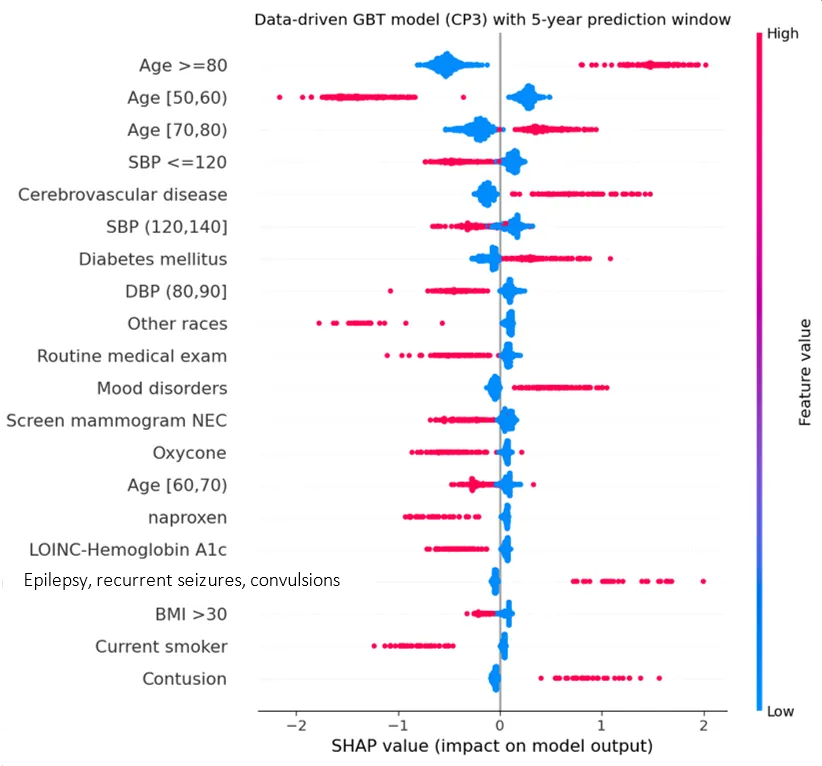
Gradient boosting trees with data-driven features performed best, with areas under the ROC curve of 0.939, 0.906, 0.884 and 0.854 for prediction 0, 1, 3 and 5 years before diagnosis. Performance declined as the prediction window lengthened, as expected. SHAP analysis identified the clinical and sociodemographic factors contributing most to the models, with age and cerebrovascular disease among them.
Published figure
Features contributing most to the five-year model
SHAP values for the data-driven gradient boosting model predicting ADRD five years before diagnosis. Shown unmodified.
Source: Li et al., Alzheimer's & Dementia 2023, CC BY-NC-ND 4.0
What it does not show
These are retrospective models in one research network. External validation in other populations, and evidence that earlier identification changes care, are separate questions that this study does not answer.
Later work
A 2026 paper in JAMIA Open, on which I am the second author, examined whether factors related to ADRD can be identified in real-world data.
First published on my earlier site, andeeli.github.io/posts/AD-Prediction/, and revised for this one.